Modern politics often argues as if the only options are capitalism or socialism, a more aggressive market or a more centralized state. The Dual Market State begins from a different question: can a society preserve freedom, entrepreneurship and competition while also giving the citizen a stable civic floor?
This matters because AI, automation, ChatGPT, OpenAI, Google, Facebook and the wider platform economy are changing the Future of Work. If capital and computation concentrate while ordinary people face inflation, inequality and a housing crisis, democracy becomes emotionally and materially unstable.
In Israel, public debate is often absorbed by Netanyahu, coalition politics, cost of living and identity conflict. Those questions matter, but beneath them sits a structural problem: the existing state model struggles to answer a future society shaped by AI economy, post capitalism pressures and rapid technological power.
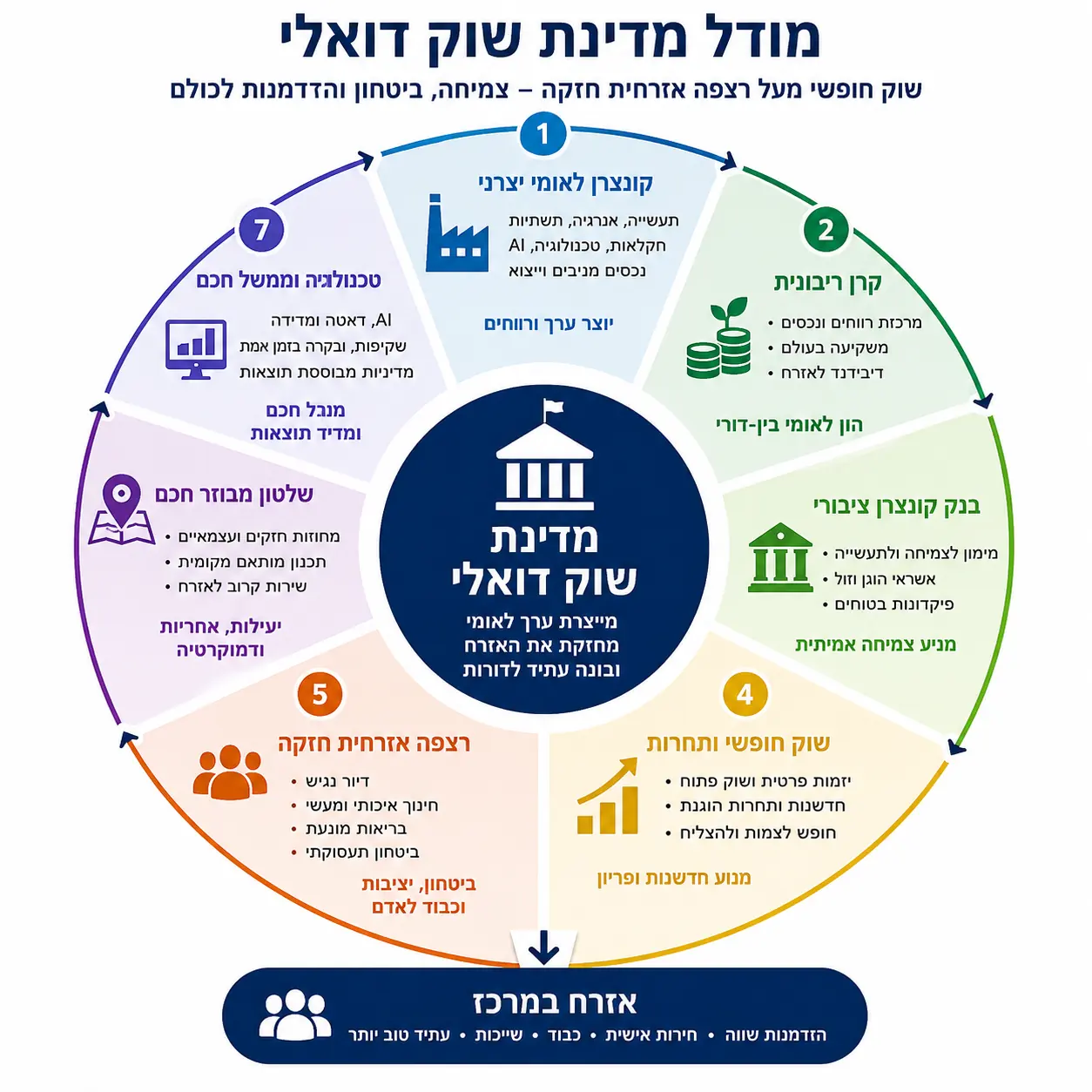
The model therefore proposes two connected tracks. The market track remains open for builders, entrepreneurs, investors and creators. The civic track gives citizens access to housing, training, work, education, health and infrastructure without forcing everyone into the same lifestyle.
The economic engine is a dual bank, a fund, a productive national corporation and a non-liquid capital loop. Instead of money leaking only into debt, speculation and external ownership, value is reinvested into the public productive system. The goal is not to abolish markets; it is to stop the citizen from being crushed by them.
Future governance will need more than slogans. It will need measurement, transparency, AI-assisted oversight, public accountability and a state that can produce real value. That is the central claim of the Dual Market State: the future state must be both free and stabilizing, both innovative and protective.